
One root, many systems.
The autonomic nervous system links many internal functions — NESA supports them non-invasively.
Information for healthcare professionals
Do you recognise yourself?
A body locked in “alarm mode”
Like a body in “alarm mode” all day — spending and storing poorly. Chronic stress (cortisol) favours metabolic syndrome; the vagal “brake” is linked to a calmer metabolism.
Self-assessment, not self-diagnosis — discuss with a professional.
Non-invasive modulation of the autonomic nervous system.
Systemic effect
Support for multiple autonomic functions.
Sleep
Improved sleep quality.
Stress
Reduction of physiological stress.
Microcurrents that restore autonomic balance.
NESA applies controlled low-intensity (0.1–1 mA) low-frequency (1–15 Hz) microcurrents through eight electrodes on the four limbs and one guide electrode. The signal reaches the autonomic nervous system and restores the balance between its sympathetic and parasympathetic branches.
Internal medicine sees autonomic dysregulation more often than any other specialty — as fatigue without a finding, disturbed sleep, metabolic risk and complaints that do not settle into a single diagnosis. That is the level NESA works on.
Where NESA is applied in internal medicine.
NESA makes the autonomic balance measurable: HRV and sleep quality are tracked objectively before and after the protocol.
Source: manufacturer NESA (NGS Health and Mind S.L.), post-market surveillance system, as of July 2026, and more than 20 peer-reviewed publications with journal and PMID. These are general data on the method, not results of a study in this particular specialty. Individual results may vary. Information for healthcare professionals.
A clear frame for the treatment course.
A typical course in internal medicine. Parameters are adapted individually and combined with the ongoing therapy and monitoring.
Made for internal medicine practice.
General practitioners and internists
The first place where fatigue without a finding reaches a doctor.
Diagnostic and consultative centres
A non-invasive addition with objective markers.
Prevention programmes
Autonomic monitoring in raised risk.
Download the NESA presentation.
Mechanism, indications, protocols and clinical data for implementing NESA.
Short answers for professionals.
Is the therapy safe?
Yes. NESA is a non-invasive, low-intensity method with no known systemic side effects. The manufacturer records zero reported serious adverse events across more than six million treatments delivered. Sessions are carried out by a trained practitioner.
Does it replace medication?
No. NESA complements treatment by working on autonomic regulation within standard care.
How is the effect measured?
Objectively — through heart rate variability and sleep quality, tracked before and after the protocol.
In which patients does it make most sense?
In those whose tests are normal while the complaints remain: fatigue, disturbed sleep, functional symptoms. Organic causes are excluded first.
Explore adjacent areas.
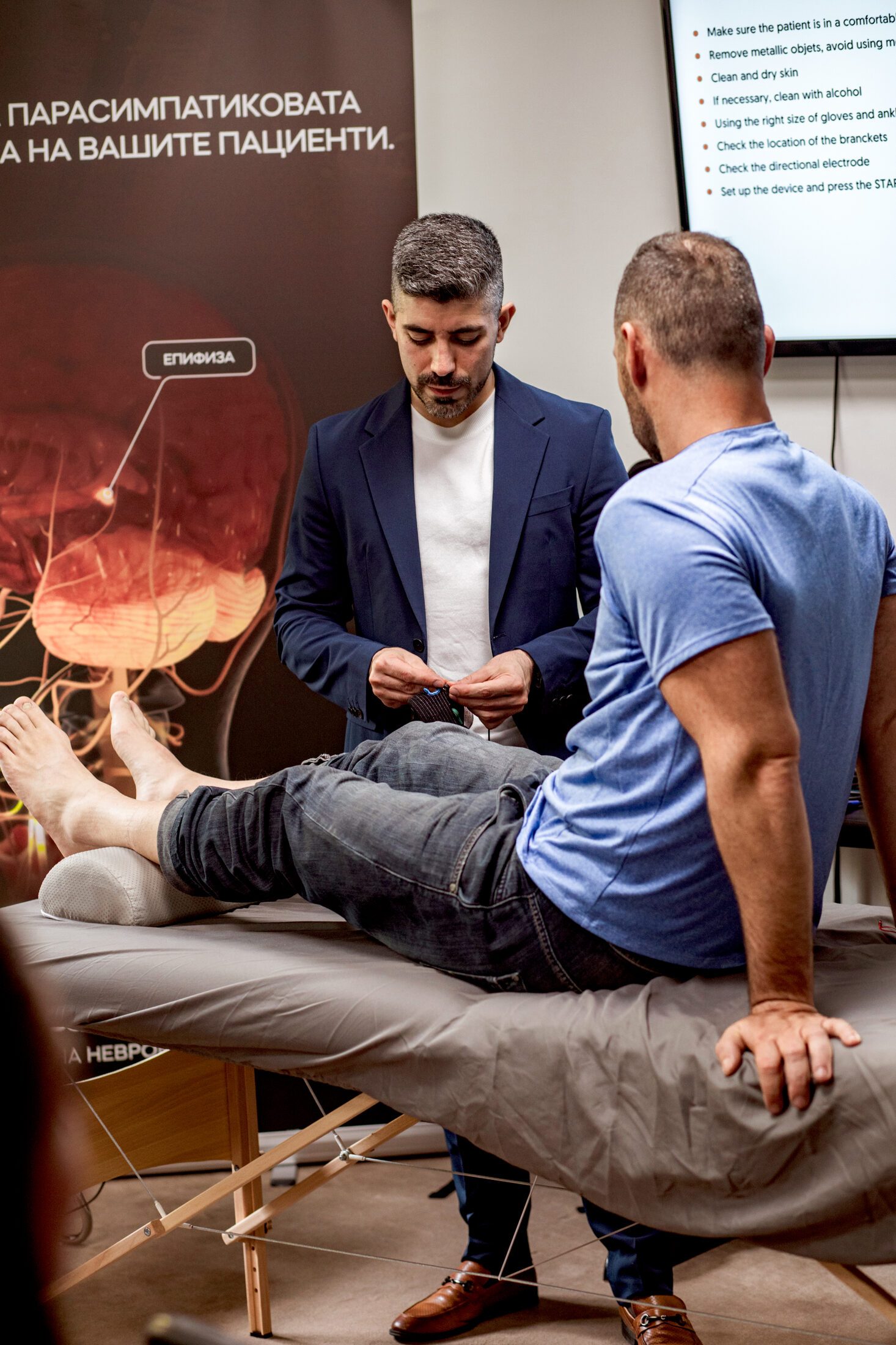
Microcurrents through the wrists and ankles — the whole autonomic axis at once.
Bring NESA into your practice.
Real values from the handbook (INF-CD-022)
Non-specific arterial hypertension
Acute or chronic constipation
Source: NESA protocol handbook · INF-CD-022 (2025-V.1). Standard session 60 min, LOW mode by default.
At the core: programmes P1–P9
Every protocol in this field combines the reference programmes P1–P9 — general homeostasis, body levels, ANS/CNS and targeted nerves — according to the clinical goal.
See programmes P1–P9 →Protocols are guidelines.
Parameters are guides; the therapist adapts them to the patient.
NESA is applied after individual assessment — as part of the overall medical plan.
Absolute contraindications (pacemaker, pregnancy, active electrical implants) follow the device IFU.
Before you invest — the independent assessment.
We map clinical goals, workflows, budget and reimbursement — then recommend the solution that meets the department’s needs, not the easiest to sell.
Where can I get a NESA session?
The authorised centres in Bulgaria — Sofia, Plovdiv and Pleven — with address, phone and contact person.
NESA information pack
Enter your e-mail, confirm with one click — and the NESA presentations (BG · DE · EN) arrive automatically. Free, no spam.