
Dignity, sleep and autonomic balance.
In elderly patients NESA improves sleep and autonomic balance — measurable via HRV.
Information for healthcare professionals
Non-invasive modulation of the autonomic nervous system.
HRV
Significant improvement in variability.
Sleep
Better sleep quality.
Function
Support for cognitive function.
Study results; individual results may vary. Information intended for healthcare professionals.
Download the NESA presentation.
Mechanism, indications, protocols and clinical data for implementing NESA.
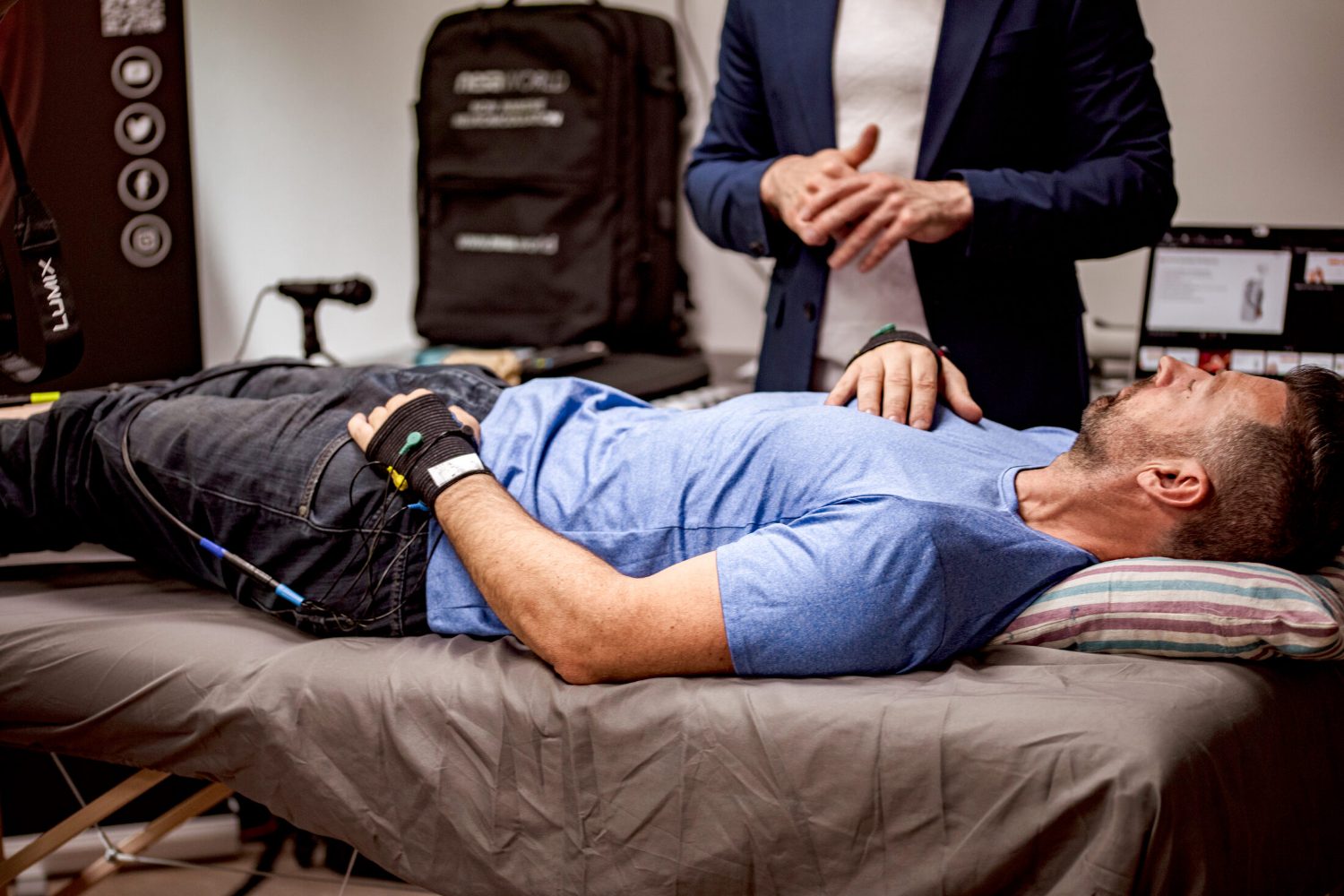
Microcurrents through the wrists and ankles — the whole autonomic axis at once.
Not a single symptom, but the capacity for self-regulation.
With age the sympatho-vagal balance often shifts against vagal tone — the body stays in heightened activation, recovery and sleep suffer. Durable vagal tone is a marker of adaptability and resilience. NESA aims exactly at improving vagal tone and flexible autonomic regulation — a common foundation on which many age-related complaints converge. HRV makes changes traceable and allows management by the individual course.
Clinical fields: quality of life in the elderly (C1 — open count; P1, P2, P4, P5, P7, P8; electrode C6–C7, C4 or mesenteric; WeCardio, EQ-5D) and adjuvant anti-aging/longevity therapy (C4 — P1, P2, P5, P7 partly 45 min / HIGH, P8; electrode sternum, C4, mesenteric, C6–C7; WeCardio/WHOOP, actigraphy). Three phases: central → metameric → focal. 60-min session, LOW by default; in geriatrics, a gentle start with close monitoring.
For geriatrics there is early published data supporting the mechanism. This is early, supporting evidence with measurable results.
sleep quality, −58% daytime sleepiness, +35% cognitive function in dementia — Teruel-Hernández, IJERPH 2023.
objective marker of autonomic balance — measured with WeCardio before and after the protocol (reference: SDNN ≈ 50 ms).
Limits & safety: NESA is applied after individual medical assessment. Protocols are guidelines; they complement geriatric care. XSIGNAL is a medical device — applied after individual assessment. In elderly and multimorbid people — careful counselling, gradual escalation and ongoing monitoring. Absolute contraindications: pacemaker and pregnancy.
Bring NESA into your practice.
Real values from the handbook (INF-CD-022)
Quality of life in older adults
Source: NESA protocol handbook · INF-CD-022 (2025-V.1). Standard session 60 min, LOW mode by default.
At the core: programmes P1–P9
Every protocol in this field combines the reference programmes P1–P9 — general homeostasis, body levels, ANS/CNS and targeted nerves — according to the clinical goal.
See programmes P1–P9 →Protocols are guidelines.
Parameters are guides; the therapist adapts them to the patient.
NESA is applied after individual assessment — as part of the overall medical plan.
Absolute contraindications (pacemaker, pregnancy, active electrical implants) follow the device IFU.
Before you invest — the independent assessment.
We map clinical goals, workflows, budget and reimbursement — then recommend the solution that meets the department’s needs, not the easiest to sell.
NESA information pack
Enter your e-mail, confirm with one click — and the NESA presentations (BG · DE · EN) arrive automatically. Free, no spam.