Bioresonance or neuromodulation — what does the science say?
Both methods use electrodes. The similarity ends there. This article compares the physical principles, clinical evidence and regulatory status — so you can make an informed decision.
Information for healthcare professionals
Electrodes, cables, 'signals' — but not the same thing.
When a clinic evaluates equipment, bioresonance devices and NESA XSIGNAL® often come up in the same conversation. Visually — electrodes, cable, software — they look related. The differences, however, are fundamental: in the physics behind the method, in the availability of peer-reviewed clinical evidence, and in regulatory recognition.
This article presents both methods on the basis of published data, without marketing. The goal is to let the healthcare professional or clinic manager compare the principles before investing.
What is bioresonance therapy
Bioresonance was developed in 1977 by Franz Morell and engineer Erich Rasche (MORA therapy, Germany). Current brands include BICOM, MORA, Rayonex, and others. The method claims the body emits 'pathological' and 'harmonious' electromagnetic frequencies; the device captures them through electrodes, inverts the 'diseased' ones and returns the 'corrected' signal.
In practice, the devices measure skin conductance — similar to a polygraph. There is no published technical specification of the 'therapeutic frequencies,' and independent testing has not confirmed that the devices distinguish living tissues in any specific way.
LBI-HTA (Austria, 2009): of 57 publications only 6 met the criteria. Allergies: no superiority over placebo; diagnostic agreement 22%.
Ernst E. (2004): the method is described in 'pseudoscientific language'; no controlled evidence of an effect above placebo.
ASA (UK, 2015–2021): all advertising claims for bioresonance diagnosis and treatment ruled misleading.
Excluded from statutory health insurance in Germany (G-BA); broadly without private insurance coverage in DE/AT.
What is NESA XSIGNAL®
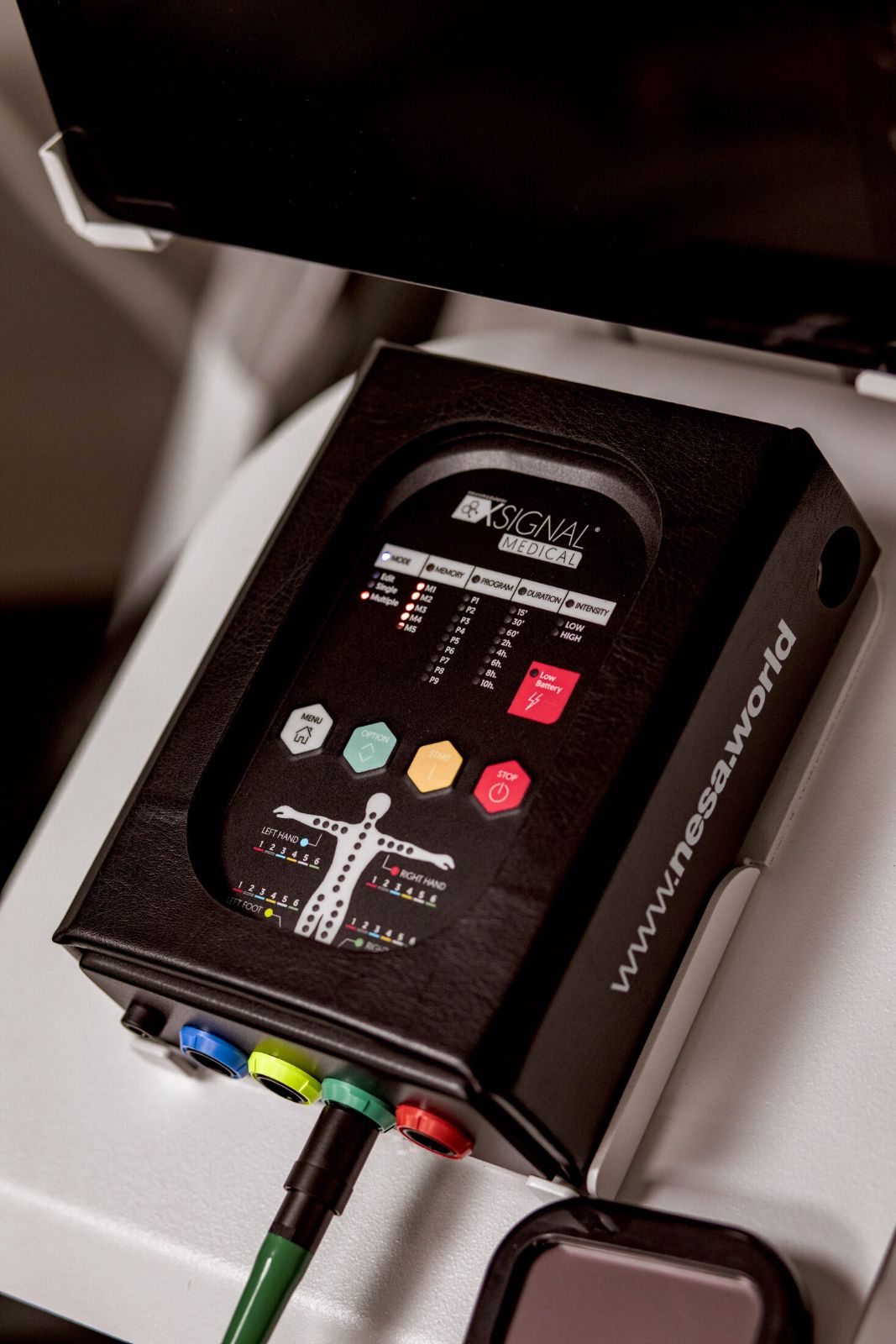
Non-invasive neuromodulation with low-intensity microcurrent (sub-sensory mode), applied through 8 peripheral electrodes on the limbs and 1 guiding electrode positioned centrally, segmentally or focally. Session: 60 minutes, 9 standardised programmes (P1–P9).
The target is the autonomic nervous system: vagal tone, sympatho-parasympathetic balance, descending pain modulation and vascular response. The effect is visible during the session via the WeCardio ECG module (HRV: SDNN, RMSSD) and confirmed with validated questionnaires.
Class IIa medical device, CE-marked under Regulation (EU) 2017/745 (MDR).
Manufacturer: NGS Health & Mind S.L., Spain.
University expert course in neuromodulation; NESA Campus for therapist certification.
4 randomised controlled trials (2022–2025) and 9+ clinical series in peer-reviewed journals.
Two methods, different foundations.
| Criterion | Bioresonance | NESA XSIGNAL® |
|---|---|---|
| Physical principle | 'Pathological frequencies' and 'scalar waves' — no physical theory, no measurable dose | Microcurrent with defined intensity and duration; peripheral and autonomic nerve electrophysiology |
| What the device actually does | Measures skin conductance; the 'therapeutic' signal has no published specification | Delivers a known current dose (0.1–1 mA, 1–15 Hz) through 9 electrodes per a standardised map; every session is reproducible |
| Target of action | Undefined ('the body's information field') | The autonomic nervous system: vagal tone, sympatho-parasympathetic balance, descending pain modulation |
| Measurable in-office effect | No objective metric; the result is subjective reporting | ECG HRV (WeCardio) before/after; heart rate; pain threshold; vascular ultrasound |
| Controlled trials | 2 RCTs in 45 years, no effect above placebo (LBI-HTA, 2009) | 4 RCTs (2022–2025), one triple-blind, plus 9+ clinical series in peer-reviewed journals |
| Regulatory status | Some devices CE-marked under the old directive; advertising sanctioned by ASA, TGA; no reimbursement | Class IIa medical device, CE-marked under MDR 2017/745; clinical evaluation; authorised distributor |
| Training | Manufacturer courses, no academic verification | University expert course; NESA Campus; clinical dossier with P1–P9 protocols |
| Patient responsibility | Risk of delaying proven treatment (ASA, 2021) | Complement to treatment, not a substitute; protocols include contraindications and stopping criteria |
Comparison based on published peer-reviewed sources; it does not constitute medical advice.
Selected peer-reviewed studies with DOI — measurable results, not promises.
| Study | Design | Result |
|---|---|---|
| Mínguez-Esteban et al., Frontiers in Neuroscience 2024 | RCT, placebo-controlled; 40 healthy adults | Carotid vasodilation +15.7%; lower HR vs placebo |
| Melián-Ortíz et al., Brain Sciences 2025 | RCT, triple-blind; 16 women, post-COVID | Pain threshold +62.9%; raised SDNN; improved sleep |
| Blasco-Bonora et al., J. Clin. Med. 2025 | RCT; 24 women, overactive bladder | Symptoms −68.6%; better quality of life; improved PSQI |
| García et al., Frontiers in Physiology 2022 | RCT; 12 professional basketball players | Lower nocturnal HR; fewer night awakenings |
| Teruel-Hernández et al., IJERPH 2023 | Multicentre; 30 dementia patients | Sleep quality +40%; cognitive function +35% |
| Báez-Suárez et al., BMC Pediatrics 2023 | Pre/post; 23 children with neurodevelopmental disorders | +1.74 h sleep; −69.5% interruptions; 90% normalised bowel rhythm |
The evidence for NESA is real but young: samples range from 12 to 40 participants, some studies are pilot or observational, and larger multicentre RCTs are forthcoming. The difference from bioresonance is not 'lots of evidence vs a little,' but a measurable mechanism and peer-reviewed controlled trials vs zero of either in 45 years.
What neuromodulation can do that bioresonance cannot.
Measurable effect on the spot
The WeCardio ECG module records the HRV change during the session. Patient and physician see a number — not a feeling.
Dosable and reproducible
Intensity, programme and electrode position are defined. Two sessions in two clinics deliver the same therapy.
Citable by DOI
Every claim is backed by a DOI from a peer-reviewed publication — the only way to talk to physicians, hospitals and insurers.
Evidence-based medicine.
Not promises.
4 randomised controlled trials · Class IIa medical device · measurable effect with WeCardio
Bioresonance and NESA — clarified.
Does bioresonance work?
In 45 years it has not produced a single randomised controlled trial showing an effect above placebo that survived independent review. There is no published physical theory behind the method.
How is NESA different from bioresonance?
NESA delivers a defined microcurrent through the peripheral nervous system to produce a measurable change in autonomic balance (HRV). Bioresonance claims to manipulate undefined 'body frequencies.' One method has controlled trials in peer-reviewed journals, the other does not.
Can I add NESA alongside bioresonance?
NESA is a medical device that works in parallel with any recognised treatment. The training is self-contained and does not require prior bioresonance experience.
I have a bioresonance device in my practice — what should I do?
The decision is yours. NESA does not replace devices — it adds measurable neuromodulation to your practice. Many professionals complement their existing equipment without discarding anything.
Experience the difference live.
Request a demonstration with WeCardio measurement — see the effect before and after the session.
Before you invest — the independent assessment.
We map clinical goals, workflows and budget — and recommend the solution that fits your practice.
Where can I get a NESA session?
The authorised centres in Bulgaria — Sofia, Plovdiv and Pleven — with address, phone and contact person.
NESA information pack
Enter your e-mail, confirm with one click — and the NESA presentations (BG · DE · EN) arrive automatically. Free, no spam.