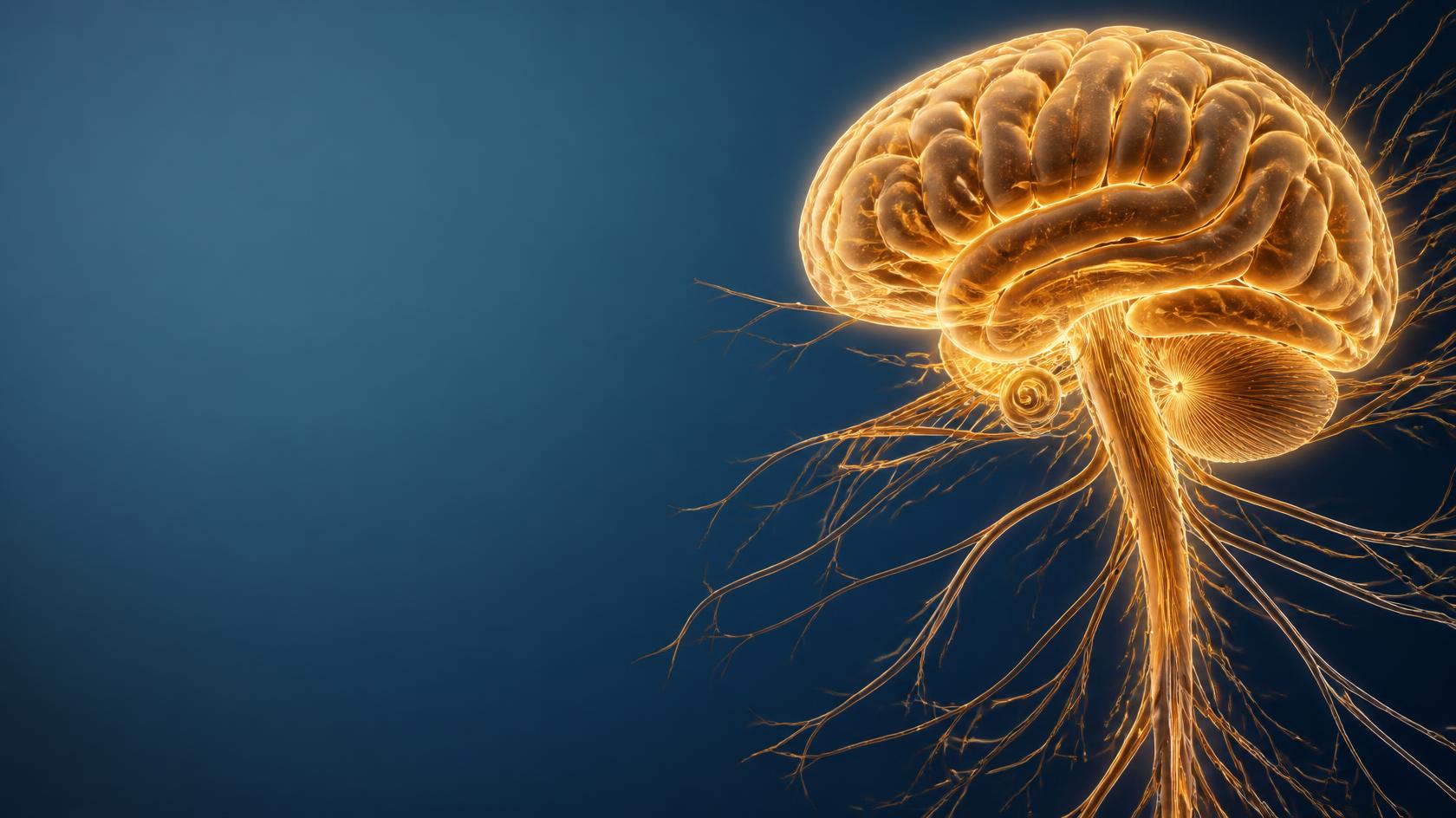
The body will not lift its foot off the pedal.
There is no specific danger, and the system responds as if there were. Tight shoulders, shallow breathing, a heart that starts up for no reason — and the impossibility of simply letting go.
What it looks like day to day.
If you recognise three or more, it is worth looking not at each complaint separately, but at the system that connects them.
- 01You feel tension in the body even when nothing is happening
- 02You breathe shallowly and high in the chest without noticing
- 03The heart starts up at small things and settles slowly
- 04Concentration is hard — the mind jumps
- 05Days off do not restore you
The complaint is on the surface. The control sits deeper.
The stress response is normal and useful: the sympathetic branch mobilises the body, then the parasympathetic brings it back down. The problem is not the alarm — it is the missing return.
Under sustained load the system loses its flexibility. It stays up. This is measurable: heart rate variability drops, recovery after effort takes longer. The body is on standby without cause — and pays for it in sleep, digestion and concentration.
NESA works on that flexibility. It does not suppress anxiety and does not affect thinking — it supports the branch of the nervous system responsible for coming down after effort.
We force nothing. We speak the language the body already uses.
NESA XSIGNAL® is a certified medical device for non-invasive neuromodulation of the autonomic nervous system.
Your body runs on electricity
The autonomic nervous system — the one that governs sleep, alertness, bladder and digestion — works at very low frequencies: between 1 and 14 cycles per second.
NESA speaks in the same window
Microcurrents in that same frequency range, delivered through gloves and ankle cuffs while you lie down or sit in a chair. No needles, no medication, no preparation.
The fact that you cannot feel it is why it works
The signal sits below the threshold of sensation. Because it does not trigger the body’s defences, the nervous system does not habituate to it, and the signal can accompany it session after session.
The practitioner’s hands stay free
The session runs alongside another therapy — physiotherapy, conversation, rehabilitation. Not a separate appointment, but a layer over the treatment already under way.
Manufacturer data, NESA (NGS Health and Mind S.L.), post-market surveillance system, as of July 2026. The zero refers to reported serious adverse events, not to the absence of any reaction whatsoever.
When would I notice anything?
It depends on one thing: how long the regulation has been disturbed. We say so up front, so you know what to expect — and so you do not stop after the third session because nothing has happened yet.
The first changes are usually felt here — most often in sleep and in recovery.
The more substantial change comes in this range, at a steady rhythm of two sessions a week.
With a chronic profile the work is done in blocks. After each block, a fresh assessment with objective measures, not by feel alone.
A guiding framework from practice, not a promise of results. The exact schedule is set by the practitioner delivering the treatment.
The figures come from the manufacturer — with the source.
NESA is used in clinics and hospitals across 53 countries and is the subject of more than 20 peer-reviewed publications. The manufacturer publishes the results together with the journal and PMID of each study — so anyone can check the source themselves instead of relying on a retelling.
Where this leads.
A complaint rarely belongs to one specialty alone. This is where one usually starts with it — and what each page covers.
Short answers, no hedging.
Is this a therapy for anxiety?
No. NESA is not psychotherapy and does not replace treatment for an anxiety disorder. It works on autonomic regulation — the physical side of the condition. Many practitioners use it alongside psychotherapy, not instead of it.
Can I have a session during a conversation with my therapist?
Yes, and that is a common way to use it. The practitioner’s hands stay free, the conversation continues, the neuromodulation runs in parallel.
Will it make me drowsy during the day?
Usually not. Some people describe calm after the session, not fatigue. If tiredness appears, you tell the practitioner and the schedule is adjusted.
How long does a session take?
About an hour, in a chair, with gloves and ankle cuffs. No needles, no medication, no preparation.
It rarely comes alone.
Complaints of the autonomic nervous system rarely arrive on their own. If you recognise another one here, that is most likely not a coincidence.
Where can I get a NESA session?
The authorised centres in Bulgaria — Sofia, Plovdiv and Pleven — with address, phone and contact person.
NESA information pack
Enter your e-mail, confirm with one click — and the NESA presentations (BG · DE · EN) arrive automatically. Free, no spam.