
A calm nervous system — better communication.
NESA supports speech therapy in children and adults through autonomic nervous system regulation.
Information for healthcare professionals
Do you recognise yourself?
Words that get stuck
Like a traffic light for words, driven by the fear of getting stuck. Anticipation switches on the “gas” before you even speak — a vicious cycle of anxiety.
Self-assessment, not self-diagnosis — discuss with a professional.
Non-invasive modulation of the autonomic nervous system.
Regulation
Lowering the stress that hinders communication.
Attention
Support for focus and engagement in therapy.
Sleep
Better sleep and recovery in children.
Download the NESA presentation.
Mechanism, indications, protocols and clinical data for implementing NESA.
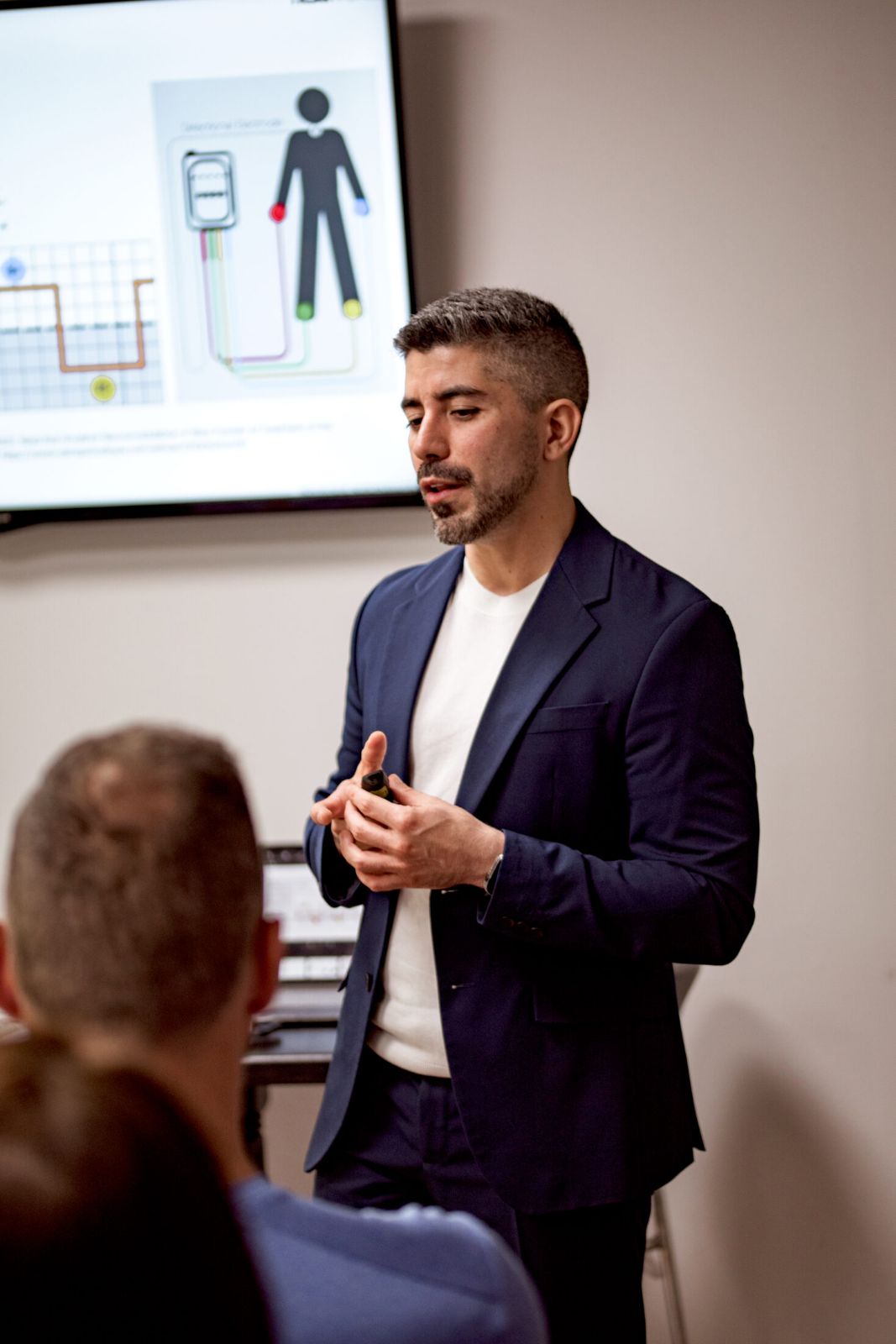
Microcurrents through the wrists and ankles — the whole autonomic axis at once.
What observations show.
We cite only sourced data. In autism-spectrum support, sleep improvement has been observed; for other speech-therapy indications the effect is general ANS regulation — lower stress, better vagal tone and HRV — without specific speech-therapy percentages.
sleep quality (patient self-report), autism-spectrum support — Neuromodulación y TEA, INFAD 2025.
sleep quality (family observation), autism-spectrum support — INFAD 2025.
Results depend on the individual, comorbidities and adherence. NESA is a complement to speech therapy — within the individual therapy plan. Data are sourced; information is for healthcare professionals.
Bring NESA into your practice.
Real values from the handbook (INF-CD-022)
Stuttering / dysphemia
Dysphagia and feeding disorders
Source: NESA protocol handbook · INF-CD-022 (2025-V.1). Standard session 60 min, LOW mode by default.
At the core: programmes P1–P9
Every protocol in this field combines the reference programmes P1–P9 — general homeostasis, body levels, ANS/CNS and targeted nerves — according to the clinical goal.
See programmes P1–P9 →Protocols are guidelines.
Parameters are guides; the therapist adapts them to the patient.
NESA is applied after individual assessment — as part of the overall medical plan.
Absolute contraindications (pacemaker, pregnancy, active electrical implants) follow the device IFU.
Before you invest — the independent assessment.
We map clinical goals, workflows, budget and reimbursement — then recommend the solution that meets the department’s needs, not the easiest to sell.
NESA information pack
Enter your e-mail, confirm with one click — and the NESA presentations (BG · DE · EN) arrive automatically. Free, no spam.