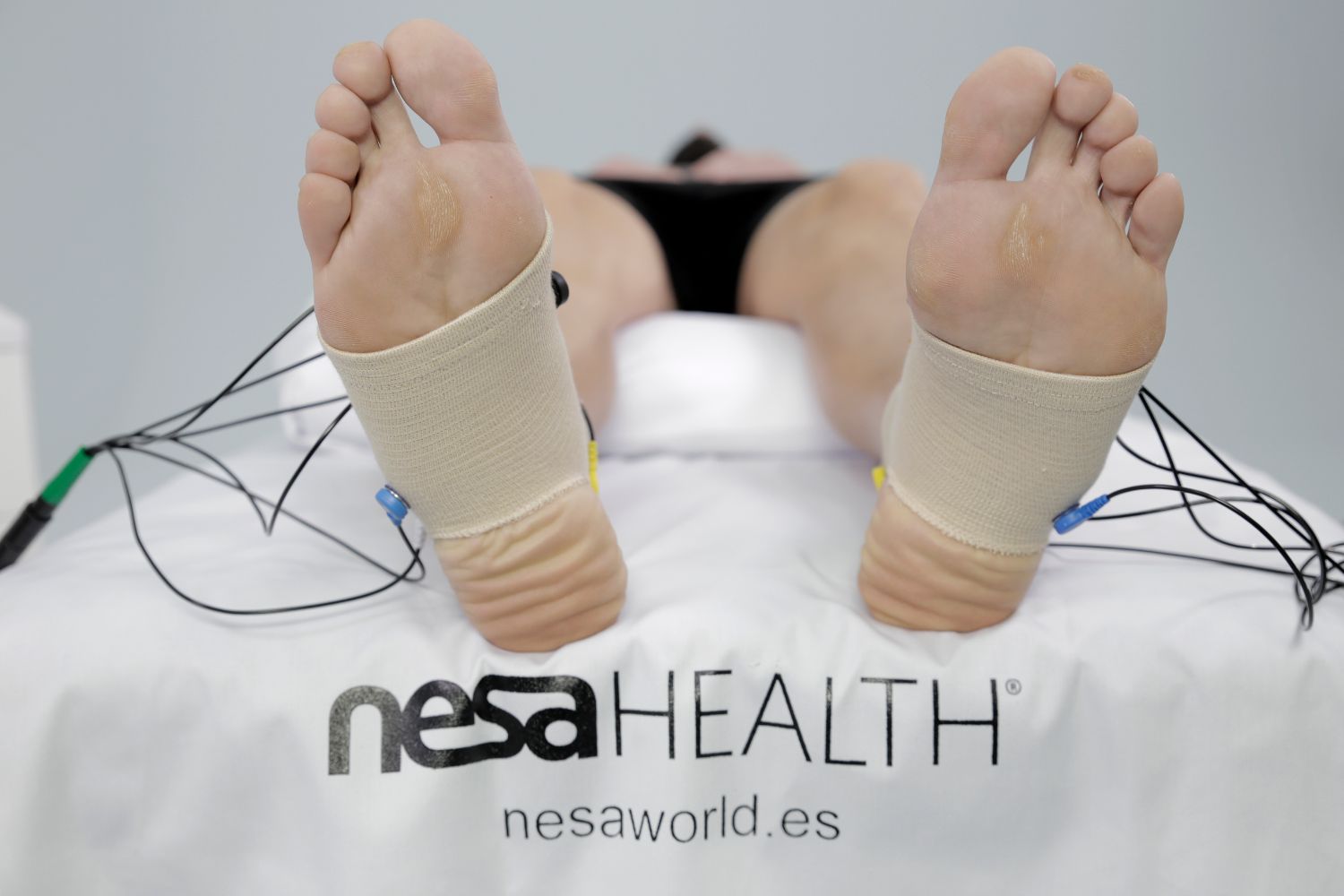
The feet — a gateway to the nervous system.
Through ankle electrodes NESA reaches the autonomic network, supporting circulation and recovery.
Information for healthcare professionals
Do you recognise yourself?
Cold feet and slow circulation
Like narrowed paths through which almost nothing flows; once the “brake” engages, the vessels widen and flow returns.
Self-assessment, not self-diagnosis — discuss with a professional.
Non-invasive modulation of the autonomic nervous system.
Circulation
Support for peripheral circulation.
Recovery
Aid in tissue recovery.
Comfort
Reduction of discomfort.
Download the NESA presentation.
Mechanism, indications, protocols and clinical data for implementing NESA.
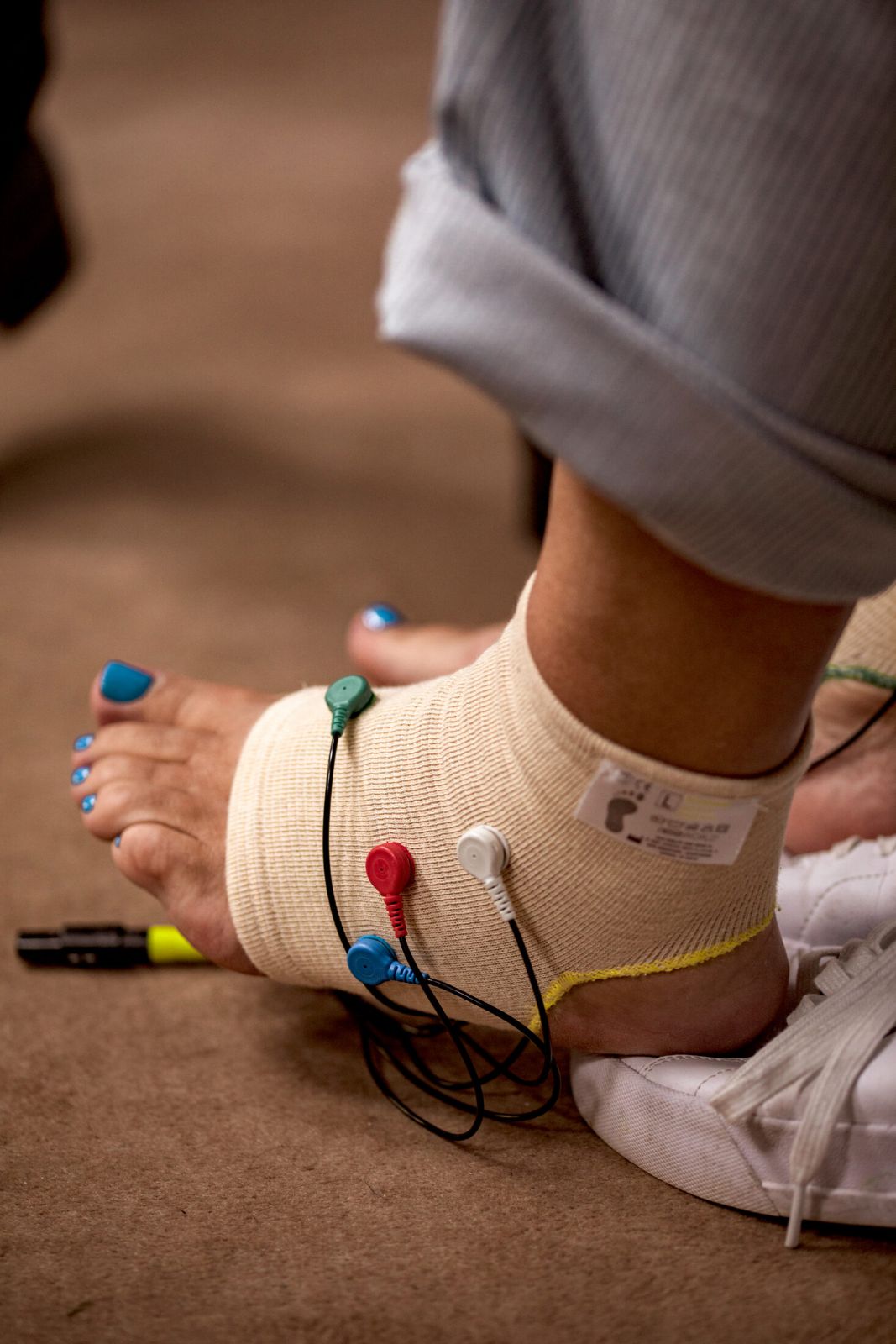
Microcurrents through the wrists and ankles — the whole autonomic axis at once.
The foot — the peripheral end of the neurovascular axis.
The sympathetic system controls vasoconstriction/dilation of small vessels (tissue trophism) and sudomotor sweat-gland activity. Unbalanced autonomic control shows up as impaired healing, altered pain or excessive sweating. NESA addresses this regulation via well-defined nerve territories (tibial posterior, superficial/deep peroneal, femoral branches).
Clinical fields: diabetic foot & tissue regeneration (F1 — target territories P2/P3/P4, HIGH; thigh cuff to avoid ulcer contact), plantar fasciitis (F2 — P7 HIGH only if no response after 10 sessions), hyperhidrosis (F3 — 50 sessions; treat any anxiety component first). Three-phase lead electrode: central (sternum, C6–C7) → metameric (L5–S1) → focal. 60-min session, LOW standard; HIGH only where specified.
For podiatric indications we build on NESA's general ANS evidence. Application is mechanism-based — autonomic regulation of microcirculation, regeneration and sudomotor activity. As a general principle (not a podiatric endpoint):
HRV (SDNN) and vagal tone (RMSSD).
carotid vasodilation (cross-sectional area) — Mínguez-Esteban, Front Neurosci 2025.
Limits & safety: NESA is applied after individual medical assessment. Protocols are guidelines; they complement podiatric care. XSIGNAL is a medical device — applied after individual assessment. Absolute contraindications: pacemaker and pregnancy.
Bring NESA into your practice.
Real values from the handbook (INF-CD-022)
Diabetic foot ulcer
Plantar fasciitis
Source: NESA protocol handbook · INF-CD-022 (2025-V.1). Standard session 60 min, LOW mode by default.
At the core: programmes P1–P9
Every protocol in this field combines the reference programmes P1–P9 — general homeostasis, body levels, ANS/CNS and targeted nerves — according to the clinical goal.
See programmes P1–P9 →Protocols are guidelines.
Parameters are guides; the therapist adapts them to the patient.
NESA is applied after individual assessment — as part of the overall medical plan.
Absolute contraindications (pacemaker, pregnancy, active electrical implants) follow the device IFU.
Before you invest — the independent assessment.
We map clinical goals, workflows, budget and reimbursement — then recommend the solution that meets the department’s needs, not the easiest to sell.
NESA information pack
Enter your e-mail, confirm with one click — and the NESA presentations (BG · DE · EN) arrive automatically. Free, no spam.