
Calm for the eye’s fine systems.
NESA supports ophthalmic conditions linked to autonomic dysregulation, non-invasively.
Information for healthcare professionals
Do you recognise yourself?
A dry eye that does not fully respond
Like an irrigation system that barely drips; with a stronger parasympathetic “brake” the eye moistens better. Tear secretion is parasympathetically driven.
Self-assessment, not self-diagnosis — discuss with a professional.
Non-invasive modulation of the autonomic nervous system.
Regulation
Balance of autonomic responses.
Comfort
Reduction of tension and fatigue.
Recovery
Support for recovery.
Download the NESA presentation.
Mechanism, indications, protocols and clinical data for implementing NESA.
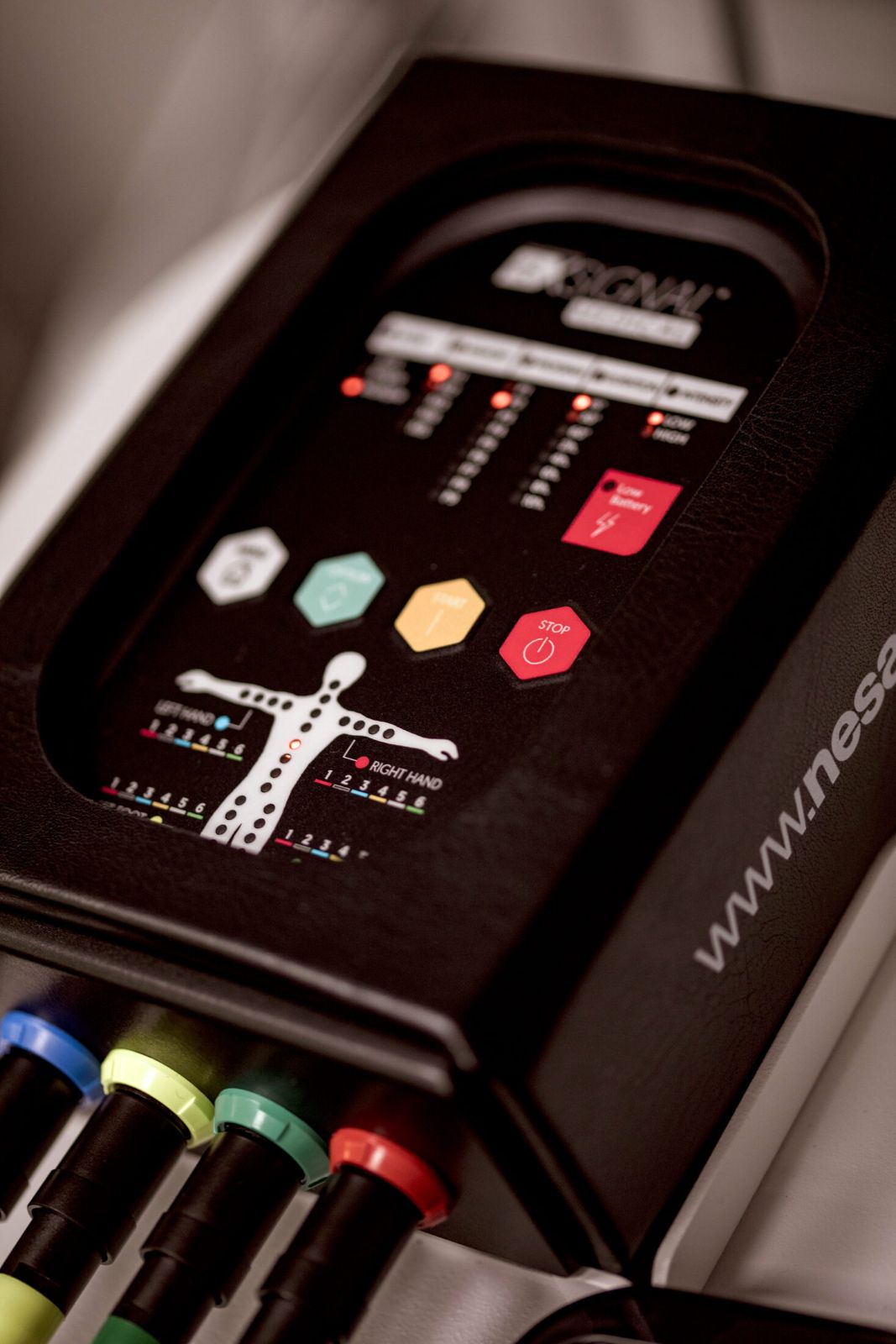
Microcurrents through the wrists and ankles — the whole autonomic axis at once.
The eye is under close autonomic control.
Pupil width, accommodation, tear-film production and ocular blood flow are regulated by sympathetic and parasympathetic input. Unbalanced autonomic regulation with sympathetic dominance can present as blurred vision, focusing problems, eye pain and changes in tear film and vascular tone. NESA addresses the autonomic regulation; many ophthalmic procedures are done on an awake patient, where the baseline autonomic state affects comfort and recovery.
Clinical fields: pre-operative anxiety (L1), acute intra-operative anxiety (L2), immediate post-operative care (L3) and dysautonomia-related visual complaints (L4 — min. 20 sessions, extendable to 30–40). Three-phase lead electrode: central (sternum, C6–C7) → metameric (C1–C2) → toward the affected zone. 60-min session, LOW; no HIGH setting is foreseen for the ophthalmic protocols.
For ophthalmology we build on NESA's general ANS evidence. The effect is mechanism-based — ANS modulation, anxiety regulation and HRV. As proof of principle:
prefrontal alpha waves (10 sessions); −30% anxiety/obsession/hostility (20 sessions) — Álvarez de los Heros, UAH 2019.
HRV (SDNN) and vagal tone (RMSSD).
Limits & safety: NESA is applied after individual medical assessment. Protocols are guidelines; they complement ophthalmic care. XSIGNAL is a medical device — applied after individual assessment. Absolute contraindications: pacemaker and pregnancy.
Bring NESA into your practice.
Real values from the handbook (INF-CD-022)
Pre-operative anxiety
Visual disturbances in dysautonomia
Source: NESA protocol handbook · INF-CD-022 (2025-V.1). Standard session 60 min, LOW mode by default.
At the core: programmes P1–P9
Every protocol in this field combines the reference programmes P1–P9 — general homeostasis, body levels, ANS/CNS and targeted nerves — according to the clinical goal.
See programmes P1–P9 →Protocols are guidelines.
Parameters are guides; the therapist adapts them to the patient.
NESA is applied after individual assessment — as part of the overall medical plan.
Absolute contraindications (pacemaker, pregnancy, active electrical implants) follow the device IFU.
Before you invest — the independent assessment.
We map clinical goals, workflows, budget and reimbursement — then recommend the solution that meets the department’s needs, not the easiest to sell.
NESA information pack
Enter your e-mail, confirm with one click — and the NESA presentations (BG · DE · EN) arrive automatically. Free, no spam.