
Breathing that follows the body’s calm rhythm.
Non-invasive modulation of autonomic control in support of respiratory function and recovery.
Information for healthcare professionals
Do you recognise yourself?
Breathing that tightens under stress
Like airways that narrow with agitation and open when the body calms. The ANS regulates bronchial calibre; with high “gas” the airways become hyper-reactive.
Self-assessment, not self-diagnosis — discuss with a professional.
Non-invasive modulation of the autonomic nervous system.
Autonomic balance
Support for parasympathetic tone.
Recovery
Aid in recovery and load tolerance.
Sleep
Better sleep quality.
Download the NESA presentation.
Mechanism, indications, protocols and clinical data for implementing NESA.
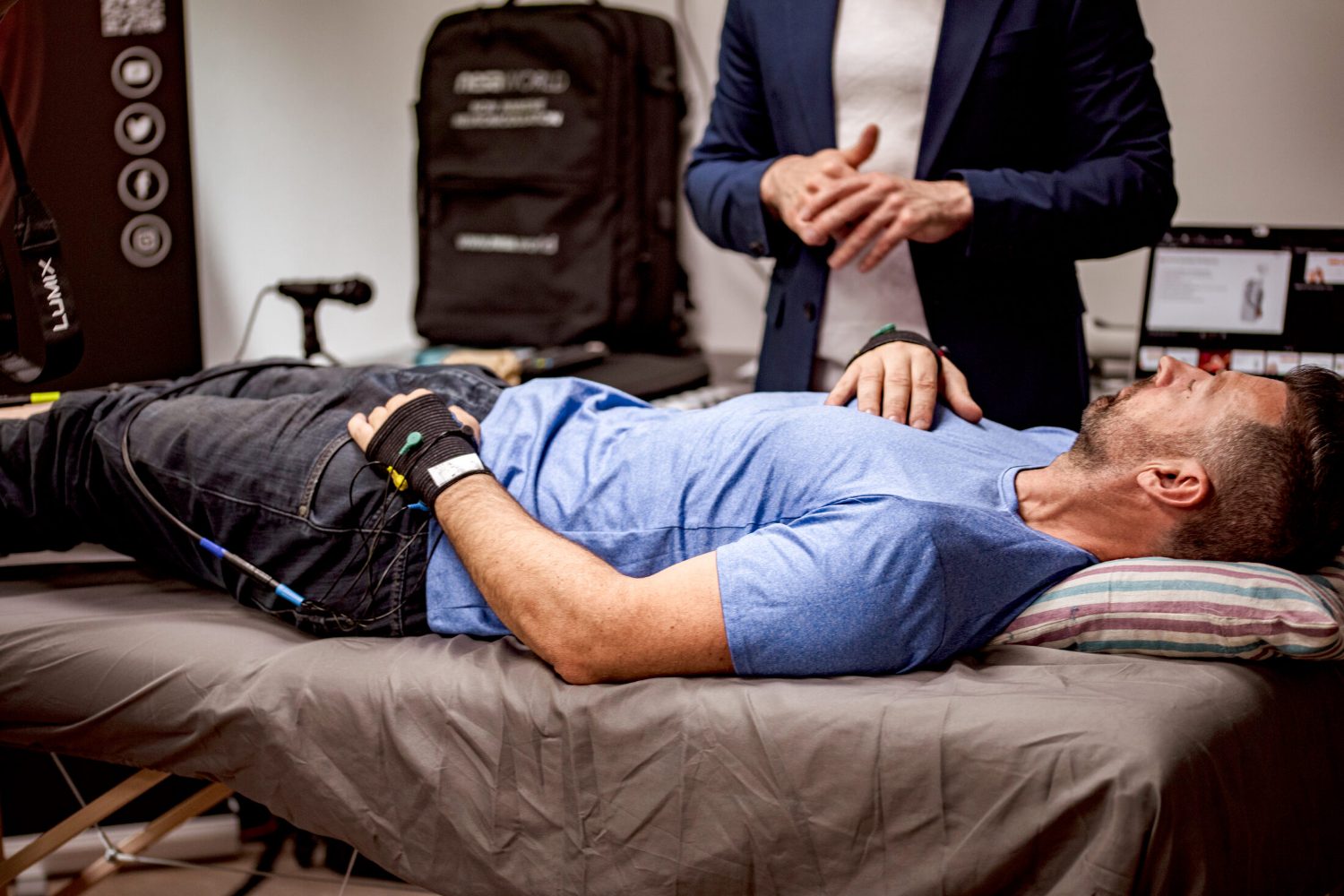
Microcurrents through the wrists and ankles — the whole autonomic axis at once.
The airways are under autonomic control.
The vagus nerve carries afferent signals from the airways and modulates cough-reflex sensitivity. A disturbed autonomic balance with sympathetic dominance can shift the threshold and amplify functional complaints such as nervous or irritant cough. NESA addresses not the lung-tissue structure but the processing and regulation of reactivity; HRV serves as an objective marker of autonomic adaptability.
Clinical fields: nervous cough (H3 — min. 20 sessions; P1, P2, P7, P8; electrode: sternum, C6–C7, nasion) and symptom management in pulmonary fibrosis (H4 — up to 20 sessions, palliative, for dry cough from parenchymal remodeling, not for COPD/productive cough; induction 3–4×/week, then maintenance up to 1×/month). Three phases: central → metameric → focal. 60-min session, LOW; no HIGH in the pulmonary protocols.
For the pulmonary indications (nervous cough, fibrosis) we build on NESA's general ANS evidence. Application is mechanism-based — aiming at improved adaptive response, not a change in structural lung status. As proof of principle:
HRV (SDNN) and vagal tone (RMSSD).
in fibrosis, application is symptomatic and palliative; sustained maintenance is needed for any effect.
Limits & safety: NESA is applied after individual medical assessment, in addition to pulmonary treatment. Protocols are guidelines; they complement pulmonary diagnostics and therapy. XSIGNAL is a medical device — applied after individual assessment. In progressive lung disease, use is coordinated with the treating team. Absolute contraindications: pacemaker and pregnancy.
Bring NESA into your practice.
Real values from the handbook (INF-CD-022)
Nervous cough
Pulmonary fibrosis symptoms
Source: NESA protocol handbook · INF-CD-022 (2025-V.1). Standard session 60 min, LOW mode by default.
At the core: programmes P1–P9
Every protocol in this field combines the reference programmes P1–P9 — general homeostasis, body levels, ANS/CNS and targeted nerves — according to the clinical goal.
See programmes P1–P9 →Protocols are guidelines.
Parameters are guides; the therapist adapts them to the patient.
NESA is applied after individual assessment — as part of the overall medical plan.
Absolute contraindications (pacemaker, pregnancy, active electrical implants) follow the device IFU.
Before you invest — the independent assessment.
We map clinical goals, workflows, budget and reimbursement — then recommend the solution that meets the department’s needs, not the easiest to sell.
NESA information pack
Enter your e-mail, confirm with one click — and the NESA presentations (BG · DE · EN) arrive automatically. Free, no spam.