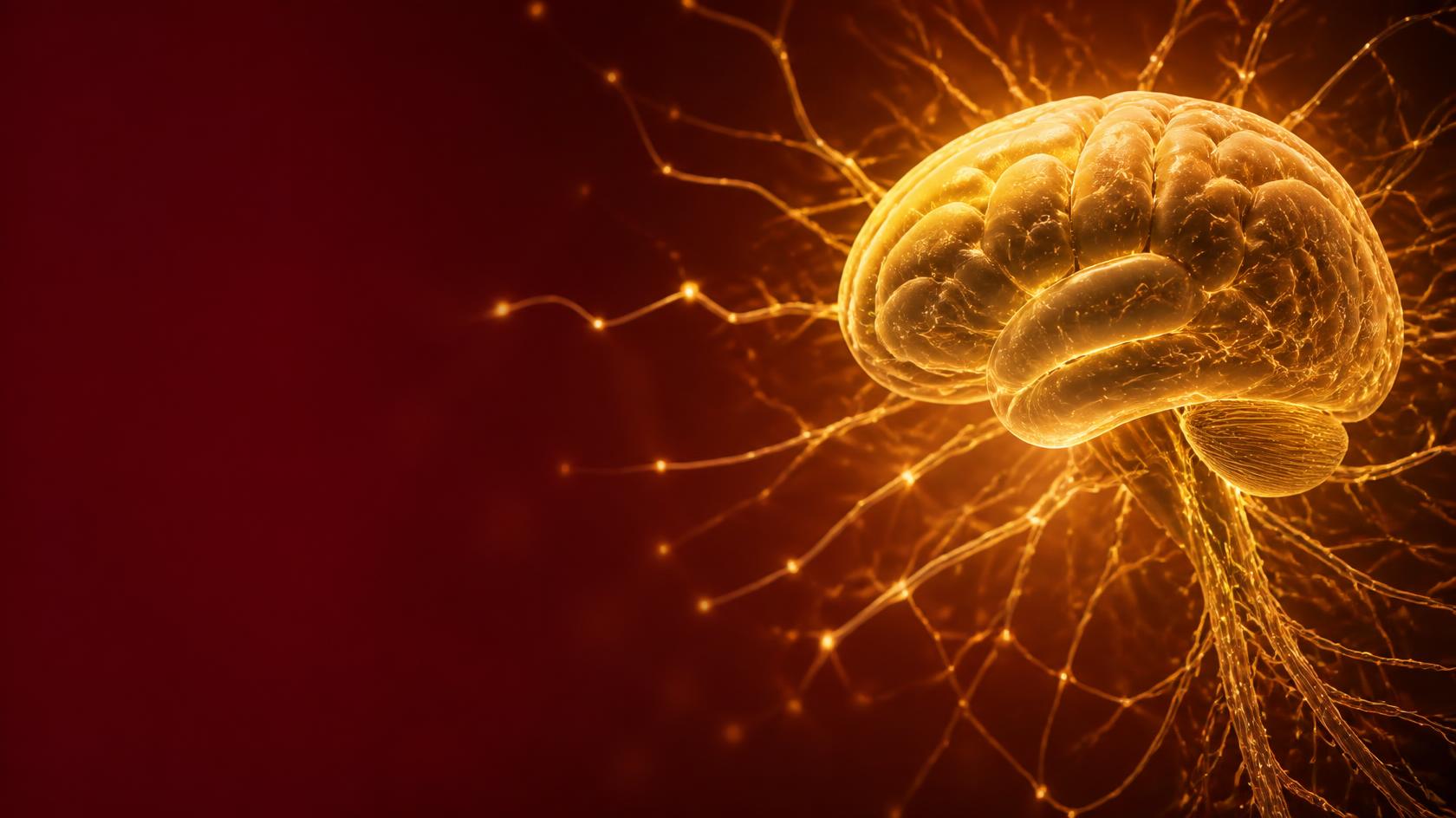
Hot flashes and a racing pulse during menopause have a neural origin, not just a hormonal one.
Hot flashes, heart palpitations, anxiety and disrupted sleep during perimenopause and menopause have a documented neuroendocrine mechanism linked to thermoregulatory centers in the brain. Their connection to the autonomic nervous system, however, is an active research area with conflicting findings — we explain what the science actually shows, honestly and with sources.
Do you recognise these complaints in yourself or in a patient?
Vasomotor symptoms affect the majority of women around the time of menopause, with varying severity and duration.
The decline in estrogen during the menopause transition dysregulates the thermoregulatory center in the hypothalamus. The result is a narrowed “thermoneutral zone” — the body reacts to minimal temperature fluctuations with a sudden widening of blood vessels and sweating: the hot flash.
Self-assessment, not self-diagnosis. Assessing severity and ruling out other causes requires a physician — a gynecologist or general practitioner.
The thermoregulatory mechanism behind hot flashes is well established — solid enough to underpin an approved drug.
A key role is played by so-called KNDy neurons (kisspeptin/neurokinin B/dynorphin) in the hypothalamus. When estrogen declines, these neurons enlarge and become hyperactivated, and an imbalance between glutamatergic and GABAergic pathways in the preoptic area of the hypothalamus narrows the thermoneutral zone and triggers vasomotor symptoms. This mechanism is described in detail in a corrected publication in PMC from 2024, summarizing the neuroendocrine findings on menopausal vasomotor symptoms.
Evidence that this pathway is well enough understood clinically: in May 2023 the FDA approved fezolinetant — an NK3 receptor antagonist that acts directly on KNDy neurons — specifically for the treatment of moderate to severe vasomotor symptoms of menopause. The approval of a drug with exactly this mechanism is strong evidence that the neuroendocrine pathway behind hot flashes is real and clinically significant.
NESA XSIGNAL® does not have a mechanism similar to fezolinetant, and it does not act on the NK3 receptor or on KNDy neurons. We mention its approval only as evidence that the neuroendocrine link between menopause and thermoregulation is sufficiently well-established science — not as a claim of similarity in mechanism of action.
Sources: corrected publication, PMC, 2024 — glutamatergic/GABAergic preoptic neurons and KNDy neuron dysregulation in vasomotor symptoms · FDA approval of fezolinetant, May 2023.
Here too, the science is divided: the link to the autonomic nervous system is not a settled question.
Thermoregulation is only half of the story. The other half — whether hot flashes lead to lasting autonomic dysregulation, measurable through heart rate variability (HRV) — is an active and, honestly, contradictory research area.
Chronic build-up of sympathetic overactivation
A review article suggests that repeated acute sympathetic activation during hot flashes may, over time, contribute to autonomic dysregulation and higher cardiovascular risk (Lee, Anselmo, Tahsin, Vanden Noven, Stokes, Carter & Keller-Ross, American Journal of Physiology – Heart and Circulatory Physiology, 2022).
A systematic review finds no significant HRV difference
A systematic review and meta-analysis of 3 studies finds no statistically significant difference in HRV between women with and without vasomotor symptoms, and concludes that larger, standardized studies are needed (Hira, Uppal, Deol, Porter, Exner, Raj & Baker, Physiological Reports, 2026).
Higher, not lower, parasympathetic tone
A 2025 study in AJP-Heart Circ Physiology finds that postmenopausal women with vasomotor symptoms show more pronounced cardiovagal modulation and higher baroreflex sensitivity — exactly the opposite of the expected sympathetic dominance.
Three serious, peer-reviewed sources — three different, partly contradictory conclusions. One study points toward chronic sympathetic overactivation, a systematic review finds no significant HRV difference at all, and another measures exactly the opposite effect — higher parasympathetic tone in women with vasomotor symptoms. This is not an error in how we're presenting it, but an honest reflection of where the science actually stands: the autonomic/HRV link to menopausal symptoms is an active but still unsettled research area, not a closed chapter.
Sources: Lee, Anselmo, Tahsin, Vanden Noven, Stokes, Carter & Keller-Ross, American Journal of Physiology – Heart and Circulatory Physiology 323(6):H1270–H1280, 2022 · Hira, Uppal, Deol, Porter, Exner, Raj & Baker, Physiological Reports, 2026 (systematic review/meta-analysis of 3 studies) · study on cardiovagal modulation and baroreflex sensitivity in postmenopausal women with vasomotor symptoms, American Journal of Physiology – Heart and Circulatory Physiology, 2025.
Neuromodulation targeting the autonomic nervous system in menopause is an early-stage research direction.
We did not find randomized controlled trials of vagal/autonomic-target neuromodulation devices specifically developed for menopausal vasomotor symptoms. Only small pilot trials exist with transcranial direct-current stimulation (tDCS) — mostly aimed at menopausal depression and mood, such as the registered trial NCT07375732 — and older pilot studies with nerve blocks. None of these is NESA, and none is directly comparable to the mechanism of NESA XSIGNAL®.
Supporting the autonomic nervous system for menopausal symptoms is an emerging, not an established, research direction.
There is no published clinical study of NESA specifically for menopausal symptoms.
Here the gap is twofold: not only is there no NESA-specific study for menopause, but the autonomic/HRV science behind the topic itself is still contested — see the section above. We do not claim or imply otherwise on either point.
Non-invasive modulation of exactly this system — within a careful, honest framework.
NESA XSIGNAL® works with controlled microcurrents through the limbs, aimed at the balance between the sympathetic and parasympathetic nervous system. This is the same system that the studies above examine in connection with menopause — but as we've seen, that science itself has not yet reached a single conclusion. NESA may help the autonomic nervous system find better balance — not because it “cures” hot flashes or anxiety during menopause, but because that is its general orientation, documented in other areas.
When NESA helps the autonomic nervous system restore its balance, it is precisely this restored function of the nervous system itself — not the device — that may contribute to easing related complaints such as tension, a racing pulse and disrupted sleep. Whether and how far this carries over specifically to menopausal symptoms remains an open question, not an established fact.
NESA XSIGNAL® has published results on heart rate variability and sleep quality — measured in other study populations (athletes, dementia patients), not in women with menopausal symptoms, but on the same physiological systems discussed above.
Heart rate variability (SDNN / vagal tone RMSSD)
In athletes: SDNN from 16 to 51 ms, vagal tone (RMSSD) from 27 to 61 ms (Medina-Ramírez, ULPGC, 2025).
Sleep quality, less daytime sleepiness (−58%)
In dementia patients (Teruel-Hernández et al., Int J Environ Res Public Health, 2023); less night-time waking (−22%) in professional basketball players (García et al., Frontiers in Physiology, 2022).
The results above come from the official database of published NESA results (nesascience.com) — measured in other study populations, not in women with menopausal symptoms. Full results map: the “Evidence” section of NESA.html.
NESA may help manage some menopausal complaints — but it does not cure them and does not replace a doctor.
NESA makes no promise of curing hot flashes, heart palpitations or anxiety during menopause — the support is directed at the autonomic nervous system, not at hormonal status.
NESA does not replace established medical options for menopause — hormone replacement therapy (HRT), fezolinetant, or other treatments prescribed by a gynecologist. Every treatment decision remains entirely with the treating physician.
Absolute contraindications (pacemaker, pregnancy, active electrical implants) follow the device's IFU.
For pronounced menopausal symptoms that affect quality of life, the first step is consultation with a gynecologist or general practitioner. Established medical options — hormone replacement therapy (HRT) and newer non-hormonal medications such as fezolinetant — remain the foundation of care for vasomotor symptoms.
Discuss your specific case with us.
For gynecologists, general practitioners and therapists: we explain the NESA mechanism, the available protocols, and how to assess whether it is a suitable tool within the patient's overall plan.
Specialised materials for you
Leave your email, confirm with one click — and the NESA presentations (BG · DE · EN) arrive automatically. Free, no spam.