
Control where it matters.
NESA shows measurable results in urinary symptoms and pelvic dysfunction through autonomic regulation.
Information for healthcare professionals
Do you recognise yourself?
Chronic pelvic pain and tension
Like a fire alarm stuck “ON” in the pelvis. The “gas” holds the tension, restricts blood supply and makes the area hypersensitive — an alarm without real danger.
Self-assessment, not self-diagnosis — discuss with a professional.
Non-invasive modulation of the autonomic nervous system.
Urinary symptoms
Reduction of symptoms (ICIQ-UI SF).
Overactivity
Resolution of detrusor overactivity.
Sleep
Improved sleep (PSQI).
Source: Conde-Santos, Medicina 2026; Arrabal-Martín, Can J Urol 2026. Individual results may vary. Information intended for healthcare professionals.
Download the NESA presentation.
Mechanism, indications, protocols and clinical data for implementing NESA.
Microcurrents through the wrists and ankles — the whole autonomic axis at once.
Bring NESA into your practice.
At the core: programmes P1–P9
Every protocol in this field combines the reference programmes P1–P9 — general homeostasis, body levels, ANS/CNS and targeted nerves — according to the clinical goal.
See programmes P1–P9 →Protocols are guidelines.
Parameters are guides; the therapist adapts them to the patient.
NESA is applied after individual assessment — as part of the overall medical plan.
Absolute contraindications (pacemaker, pregnancy, active electrical implants) follow the device IFU.
The clinical data as a shareable card.
The same numbers as above — in a ready-to-share format for colleagues, patients and social media.
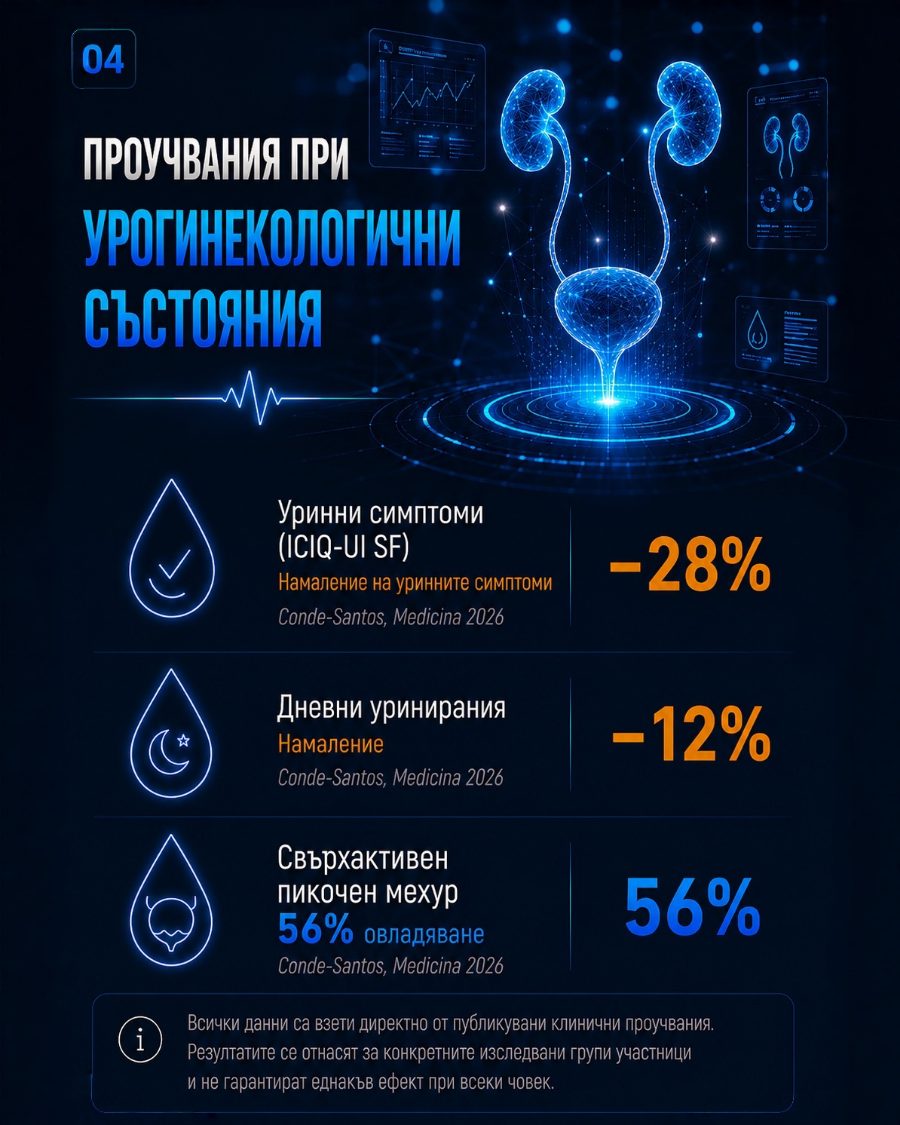
What the studies show.
urinary symptoms (ICIQ-UI SF) — Conde-Santos, Medicina 2026
daily voids — Conde-Santos, Medicina 2026
sleep disturbance (PSQI) — Conde-Santos, Medicina 2026
detrusor overactivity control — Arrabal-Martín, Can J Urol 2026
Data from peer-reviewed studies; individual results may vary. A complement — as part of the overall medical plan.
Before you invest — the independent assessment.
We map clinical goals, workflows, budget and reimbursement — then recommend the solution that meets the department’s needs, not the easiest to sell.
NESA information pack
Enter your e-mail, confirm with one click — and the NESA presentations (BG · DE · EN) arrive automatically. Free, no spam.