
The skin reflects the nervous system.
Non-invasive neuromodulation supporting dermatological conditions linked to stress and autonomic dysregulation.
Information for healthcare professionals
Non-invasive modulation of the autonomic nervous system.
Regulation
Lowering stress-mediated responses.
Gut–brain–skin axis
Lowering sympathicotonia — the stress trigger.
Comfort
Reduction of discomfort.
The gut–brain–skin axis and autonomic balance.
NESA XSIGNAL® delivers controlled low-intensity microcurrents through 8 electrodes on the four limbs + 1 lead electrode. The target is not the skin directly but the autonomic nervous system: rebalancing sympathetic and parasympathetic tone, tending toward higher vagal tone and higher HRV.
In many chronic dermatoses, sympathicotonia acts as an external trigger and sustaining factor. The protocol rests on the gut–brain–skin axis — programmes toward the gut (P3) and portal circulation/liver (P4), alongside general ANS modulation.
The proven effects are on stress and autonomic balance.
The published evidence concerns the mechanism — stress, anxiety and autonomic balance — rather than skin-specific percentages.
anxiety/obsession/hostility (20 sessions); +40% prefrontal alpha waves (EEG, 10 sessions) — Álvarez de los Heros, UAH 2019.
SDNN and vagal tone (RMSSD).
The figures reflect an effect on stress and HRV — the mechanism behind many skin complaints. Data from peer-reviewed studies; individual results vary. NESA is a complement — as part of the overall dermatological plan.
Download the NESA presentation.
Mechanism, indications, protocols and clinical data for implementing NESA.
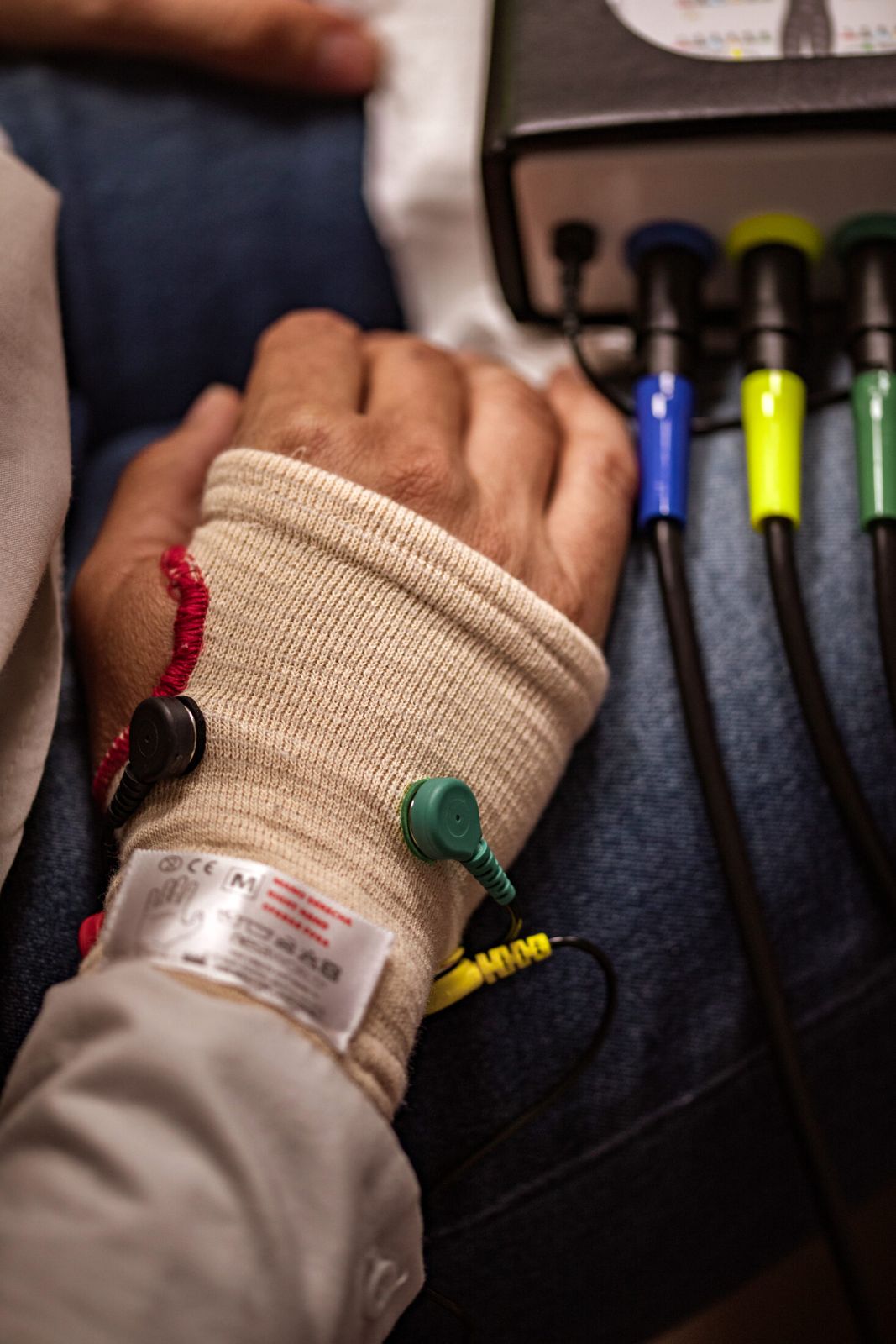
Microcurrents through the wrists and ankles — the whole autonomic axis at once.
Bring NESA into your practice.
Real values from the handbook (INF-CD-022)
Dermatoses in sympathicotonia
Stress-related psoriasis
Source: NESA protocol handbook · INF-CD-022 (2025-V.1). Standard session 60 min, LOW mode by default.
At the core: programmes P1–P9
Every protocol in this field combines the reference programmes P1–P9 — general homeostasis, body levels, ANS/CNS and targeted nerves — according to the clinical goal.
See programmes P1–P9 →Protocols are guidelines.
Parameters are guides; the therapist adapts them to the patient.
NESA is applied after individual assessment — as part of the overall medical plan.
Absolute contraindications (pacemaker, pregnancy, active electrical implants) follow the device IFU.
When the itch was gone in three days.
A patient with long-standing neurodermatitis (atopic dermatitis) had tried conventional approaches for about five years — with no lasting result. Shortly after starting non-invasive NESA neuromodulation, the itch disappeared within three days and the skin symptoms calmed.
Why this makes sense: NESA works through the autonomic nervous system — and the skin responds to it. In neurodermatitis, stress and autonomic overactivity are often a trigger and sustaining factor, and nocturnal itching disrupts sleep — the classic cycle itch → scratching → insomnia → new itch. NESA works exactly here: it calms sympathetic overactivity and improves sleep (via the stress/anxiety and sleep protocols). In this case that was enough to break the cycle.
This is a single case, a shared experience — individual results vary considerably. NESA is a complement to dermatological treatment — applied after individual assessment, as part of the overall plan. Discuss with a dermatologist.
Before you invest — the independent assessment.
We map clinical goals, workflows, budget and reimbursement — then recommend the solution that meets the department’s needs, not the easiest to sell.
NESA information pack
Enter your e-mail, confirm with one click — and the NESA presentations (BG · DE · EN) arrive automatically. Free, no spam.