
Care with delicacy and respect.
Non-invasive neuromodulation supporting intimate health through autonomic nervous system balance.
Information for healthcare professionals
Do you recognise yourself?
Pelvic floor and urinary control
Like a door whose spring doesn’t close in time — that spring is your pelvic floor. The reflex coordination is disturbed and closure is delayed.
Self-assessment, not self-diagnosis — discuss with a professional.
Non-invasive modulation of the autonomic nervous system.
Regulation
Support for autonomic functions.
Comfort
Reduction of tension.
Discretion
A non-invasive, painless approach.
Download the NESA presentation.
Mechanism, indications, protocols and clinical data for implementing NESA.
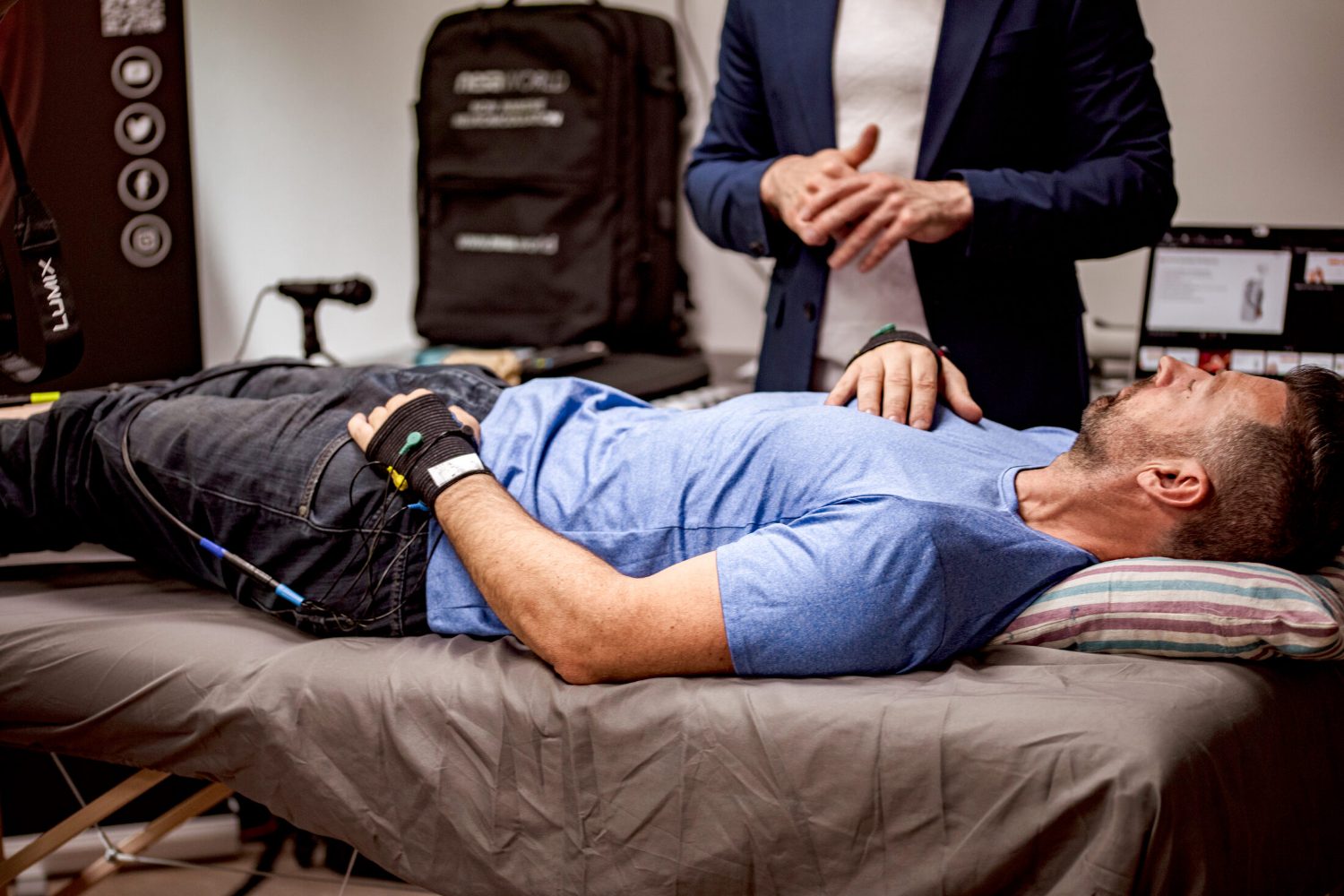
Microcurrents through the wrists and ankles — the whole autonomic axis at once.
The bladder and pelvic floor are under autonomic control.
Sympathetic pathways (thoracolumbar) support storage — relaxing the detrusor and closing the bladder neck; parasympathetic (sacral) pathways drive emptying via detrusor contraction. The pelvic floor complements this interplay. A disturbed autonomic balance can present as urgency, overactive bladder and incontinence. NESA supports a more favourable regulation of detrusor, bladder neck and pelvic floor along sacral and thoracolumbar pathways — non-invasive, without intravesical or intimate local application.
Classification: the urogynaecological application builds on the published evidence and NESA's general protocols. Therefore no specific parameters (session count, programmes, electrodes) are stated here; application rests on published evidence and the autonomic mechanism. General logic: three phases central → metameric (sacral and thoracolumbar) → focal; 60-min session, LOW; monitoring with ICIQ-UI SF, PSQI. Concrete execution is the specialist responsibility.
The urogynaecological evidence comprises two published 2026 works. They support NESA as a non-invasive option in incontinence and overactive bladder; this is emerging, supporting evidence with measurable results.
urinary symptoms (ICIQ-UI SF), −12% voids/day, −31% sleep disturbance (PSQI) — Conde-Santos, Medicina 2026.
control of detrusor overactivity — Arrabal-Martín, Can J Urol 2026.
Limits & safety: NESA is applied after individual medical assessment. Application rests on the published evidence and the mechanism. Protocols are guidelines. XSIGNAL is a medical device — applied after individual assessment. Urinary and pelvic complaints should be clarified urogynaecologically before use. Absolute contraindications: pacemaker and pregnancy.
Bring NESA into your practice.
At the core: programmes P1–P9
Every protocol in this field combines the reference programmes P1–P9 — general homeostasis, body levels, ANS/CNS and targeted nerves — according to the clinical goal.
See programmes P1–P9 →Protocols are guidelines.
Parameters are guides; the therapist adapts them to the patient.
NESA is applied after individual assessment — as part of the overall medical plan.
Absolute contraindications (pacemaker, pregnancy, active electrical implants) follow the device IFU.
What the studies show.
urinary symptoms (ICIQ-UI SF) — Conde-Santos, Medicina 2026
daily voids — Conde-Santos, Medicina 2026
sleep disturbance (PSQI) — Conde-Santos, Medicina 2026
detrusor overactivity control — Arrabal-Martín, Can J Urol 2026
Data from peer-reviewed studies; individual results may vary. A complement — as part of the overall medical plan.
Before you invest — the independent assessment.
We map clinical goals, workflows, budget and reimbursement — then recommend the solution that meets the department’s needs, not the easiest to sell.
NESA information pack
Enter your e-mail, confirm with one click — and the NESA presentations (BG · DE · EN) arrive automatically. Free, no spam.