Balance for systems sensitive to stress.
Non-invasive neuromodulation supporting andrological health through autonomic balance.
Do you recognise yourself?
Erection and autonomic balance
Like a hose with the tap half-closed — not enough blood arrives. Erection depends on the “brake” (parasympathetic); with “gas” the vessels constrict.
Self-assessment, not self-diagnosis — discuss with a professional.
Non-invasive modulation of the autonomic nervous system.
Regulation
Support for autonomic functions.
Stress
Lowering sympathetic stress.
Discretion
A non-invasive, painless approach.
What the data show — in context.
The usefulness of NESA® in overactive bladder syndrome is the subject of a published study: “Usefulness of NESA®, a new non-invasive neuromodulation system, in the treatment of overactive bladder syndrome”, Continence 7S1 (2023) 100747 — DOI: 10.1016/j.cont.2023.100747 (ICS).
SDNN and vagal tone (RMSSD).
anxiety/obsession/hostility (20 sessions) and +40% alpha waves in the PFC (EEG) — Álvarez de los Heros, UAH 2019.
night awakenings and −11% nocturnal heart rate — García et al., Front. Physiol. 2022.
points on the ejaculation profile (PEP) in premature ejaculation, pilot study — Poyato-Galán, Rev Int Androl 2026.
No IIEF or erectile-function percentages are stated here — none are published as an established outcome. The figures above concern autonomic regulation, stress and sleep and serve as an objective basis for the mechanism; andrological outcomes are assessed individually. Data from peer-reviewed studies; individual results vary. Information for healthcare professionals.
Download the NESA presentation.
Mechanism, indications, protocols and clinical data for implementing NESA.
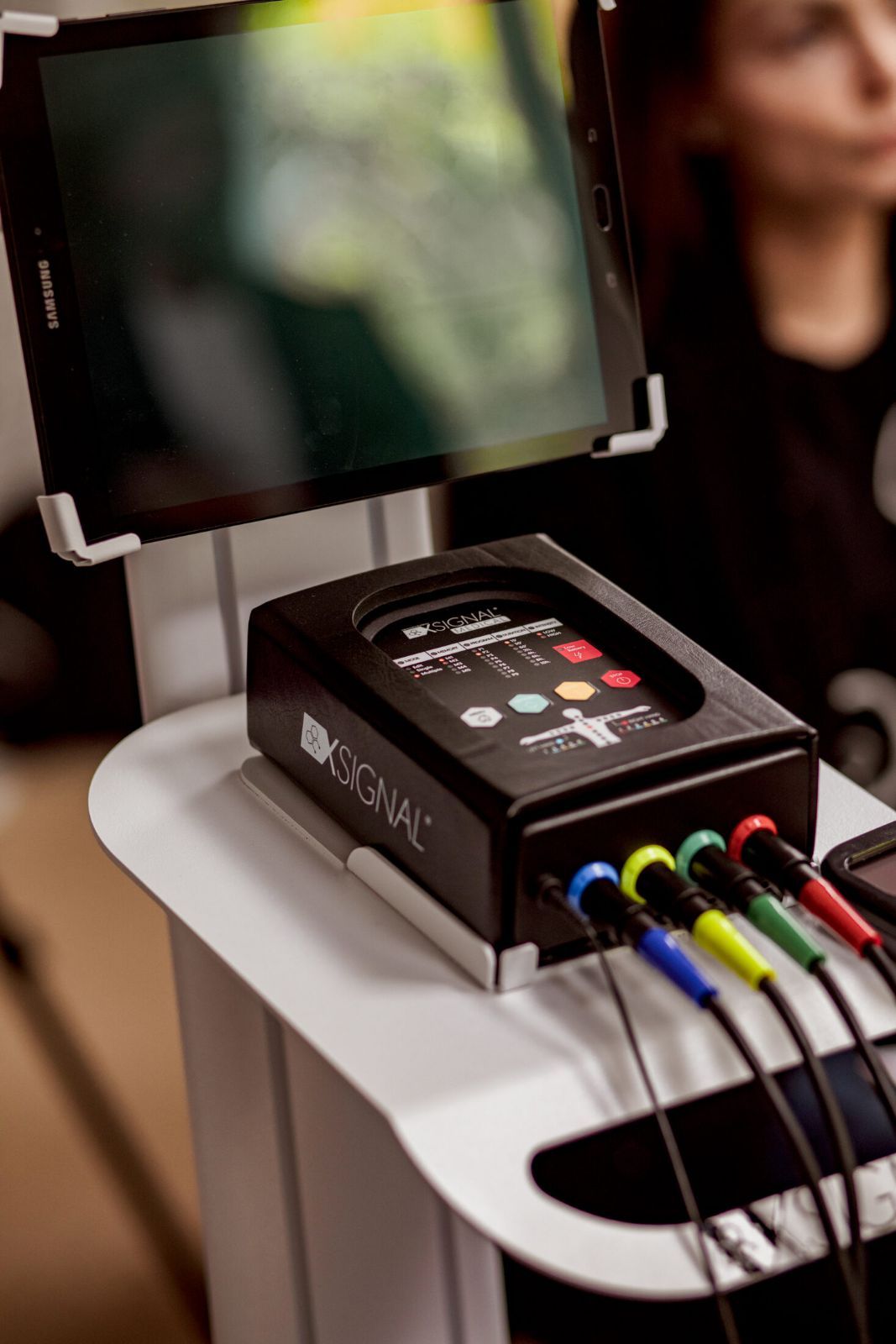
Microcurrents through the wrists and ankles — the whole autonomic axis at once.
Sexual function is an autonomically governed process.
The parasympathetic contributes to erection, the sympathetic governs key aspects of ejaculation. A shift of the sympatho-vagal balance — through stress, sustained tension or raised sympathetic tone — can present as functional and control disorders. NESA aims at a more favourable baseline via improved autonomic regulation — a supportive effect, alongside urological-andrological assessment.
Classification: the andrology application builds on NESA's general protocols. Application here is adjacent and partly pilot-stage, based on general ANS programmes. Autonomic baseline regulation: P1, P2, P7, P8; electrode sternum, C6–C7; WeCardio. Three phases: central → metameric → focal. 60-min session, LOW; fine-tuning is at the specialist discretion.
For andrology we build on one pilot study and on NESA's general ANS evidence. The data are early and allow no generalized claims or transfer to other andrological indications.
points on the ejaculation profile (PEP) in premature ejaculation — pilot study, Poyato-Galán, Rev Int Androl 2026.
HRV (SDNN) and vagal tone (RMSSD) — general ANS evidence.
Limits & safety: NESA is applied after individual medical assessment; for andrology the application is adjacent and pilot-stage. Protocols are guidelines. XSIGNAL is a medical device — applied after individual assessment. Sexual dysfunction should be clarified urologically-andrologically before use. Absolute contraindications: pacemaker and pregnancy (in a partnership context).
Bring NESA into your practice.
At the core: programmes P1–P9
Every protocol in this field combines the reference programmes P1–P9 — general homeostasis, body levels, ANS/CNS and targeted nerves — according to the clinical goal.
See programmes P1–P9 →Protocols are guidelines.
Parameters are guides; the therapist adapts them to the patient.
NESA is applied after individual assessment — as part of the overall medical plan.
Absolute contraindications (pacemaker, pregnancy, active electrical implants) follow the device IFU.
Before you invest — the independent assessment.
We map clinical goals, workflows, budget and reimbursement — then recommend the solution that meets the department’s needs, not the easiest to sell.
NESA information pack
Enter your e-mail, confirm with one click — and the NESA presentations (BG · DE · EN) arrive automatically. Free, no spam.